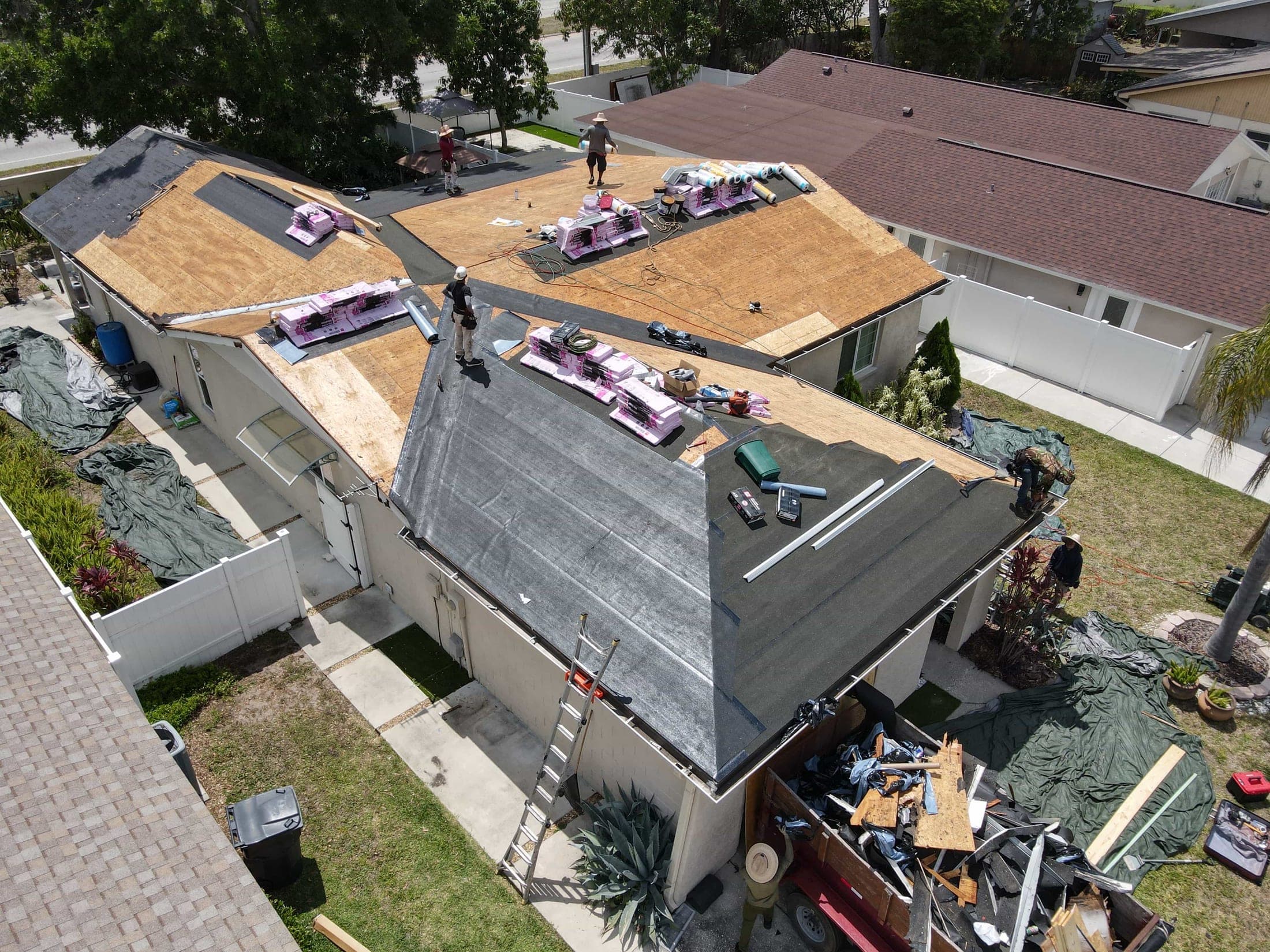
In the Tampa Bay climate, a standard architectural asphalt shingle roof lasts about 15 to 22 years, concrete or clay tile lasts 30 to 50 years (though the underlayment beneath it fails first, at 20 to 25), and a standing-seam metal roof lasts 40 to 50 years. Those numbers are shorter than the manufacturer warranty printed on the wrapper, and there is a reason for that.
Roof lifespans in Tampa Bay, by material
The table below reflects what we see in the field across Hillsborough, Pinellas, and Pasco counties, not laboratory numbers. A "50-year" shingle is a warranty term describing prorated material coverage, not a service life.
| Roof system | Realistic life in Tampa | What fails first |
|---|---|---|
| 3-tab asphalt shingle | 12–15 years | Granule loss, then thermal cracking |
| Architectural asphalt shingle | 15–22 years | Sealant strip bond, wind uplift at edges |
| Concrete or clay tile | 30–50 years (tile) / 20–25 (underlayment) | Underlayment, not the tile |
| Standing-seam metal | 40–50 years | Fastener gaskets and flashing details |
| Modified bitumen (low slope) | 15–20 years | Seam separation, ponding water |
| TPO / single-ply (low slope) | 18–25 years | Seam welds and membrane punctures |
Why Florida is harder on roofs than almost anywhere else
Four forces work on a Tampa roof simultaneously, and they compound rather than add.
1. Ultraviolet radiation and heat cycling
Tampa averages a UV index above 8 for much of the year, and a dark shingle surface routinely exceeds 160°F on a July afternoon. Asphalt is a petroleum product; UV drives off the volatile oils that keep it flexible. Then the afternoon thunderstorm drops the surface temperature 40 to 60 degrees in minutes. That daily expansion-contraction cycle is what curls shingle edges and cracks the mat, and it happens roughly 250 times a year here versus perhaps 90 in the Midwest.
2. Humidity and biological growth
The black streaks running down Tampa roofs are Gloeocapsa magma, a cyanobacteria that feeds on the limestone filler in asphalt shingles. It is not merely cosmetic: colonies hold moisture against the shingle surface and accelerate granule loss. North- and west-facing slopes that stay damp the longest almost always fail first, which is why we often see one plane of a roof visibly older than the rest.
3. Wind
Hillsborough County sits in a 130–140 mph ultimate design wind speed zone under the Florida Building Code. You do not need a named hurricane to lose a roof. The routine 50 to 60 mph gust front off a summer thunderstorm is enough to break the sealant bond on a shingle whose adhesive has already been cooked by fifteen Florida summers. Once one course lifts, the wind gets underneath and unzips the field.
4. Wind-driven rain
This is the failure mode most homeowners never anticipate. Rain moving horizontally at 40 mph does not respect gravity-based details. It travels up under shingle courses, behind drip edge, and through ridge vents that were never rated for it. This is why the secondary water barrier, the sealed layer over the deck seams, matters more in Florida than the shingle itself.
What actually adds years (and what does not)
Two identical homes on the same Carrollwood street, same shingle, same installer, can be eight years apart at end of life. The difference is almost always one of these four things.
- Balanced attic ventilation. This is the single biggest lever. You need roughly equal intake (soffit) and exhaust (ridge or off-ridge vents). Most underperforming roofs we tear off have exhaust vents and painted-shut or insulation-blocked soffits, so the attic superheats and cooks the shingles from below. Correcting this costs a fraction of a roof and can buy three to five years.
- Nailing pattern and placement. Florida requires six nails per shingle rather than four, driven in the nail zone, flush but not overdriven. An overdriven nail cuts the mat and creates a failure point; a high nail misses the course below entirely. Nailing is invisible once the roof is on, which is exactly why cheap installs cut corners there.
- Flashing and penetration detail. Roofs almost never fail in the middle of a slope. They fail at valleys, chimneys, skylights, plumbing boots, and wall terminations. A rubber plumbing boot has a 10 to 12 year life in Florida sun, half the life of the roof around it, and is a common source of "mystery" ceiling stains on a roof that is otherwise fine.
- Tree management. Overhanging limbs abrade granules with every breeze, drop debris that holds moisture in valleys, and give squirrels and rats a bridge to your fascia. Keeping canopy six to ten feet off the roof plane is cheap insurance.
Seven signs your Tampa roof is near the end
- Granules collecting in gutters or at downspout splash blocks. The shingle is losing its UV shield.
- Shingle edges curling or cupping, visible from the ground on the south or west slope.
- Bald or shiny patches where the asphalt mat is exposed.
- Nail heads visible on the surface, or shingles that have slipped out of line.
- A soft or spongy feel underfoot, indicating the plywood deck has taken on moisture.
- Daylight visible through the roof deck from inside the attic.
- Your insurer has asked for a roof inspection, raised your wind premium, or declined renewal.
The insurance clock is now shorter than the roof
This has become the practical reason most Tampa homeowners replace a roof, ahead of any actual leak. Florida property insurers have tightened underwriting sharply, and an asphalt shingle roof approaching fifteen years is now a common trigger for a non-renewal notice, a mandatory inspection, or a shift to actual-cash-value settlement, meaning depreciation is deducted and you cover the gap.
Florida law does provide a backstop: an insurer generally may not refuse to write or renew a policy solely because of the age of the roof when the roof is less than fifteen years old, or when a licensed inspector certifies the roof has at least five years of useful life remaining. That inspection is worth getting before you accept a non-renewal as final. Insurance rules in Florida change frequently, so confirm current requirements with your carrier or agent.
Repair or replace?
Our rule of thumb after a couple thousand Tampa Bay roofs: if the roof is under twelve years old and the damage is localized to one area or one detail, repair it. If it is past fifteen, the damage spans multiple slopes, or the shingles have lost enough flexibility that a technician cannot lift a course without cracking it, a repair is money spent twice. There is also a code dimension: when repairs to a roof section become extensive enough, the Florida Building Code can require the section to be brought fully up to current standards, which changes the math quickly.
An honest contractor will tell you when you have five more years. Be cautious with anyone who inspects a roof and finds a full replacement every time.
Frequently asked questions
How long does a shingle roof last in Florida?
Architectural asphalt shingles last about 15 to 22 years in the Tampa Bay climate, and 3-tab shingles about 12 to 15. That is meaningfully shorter than the same product in a northern state because of UV exposure, daily thermal cycling, humidity, and wind.
Does a 30-year shingle really last 30 years in Tampa?
No. A "30-year" or "lifetime" rating is a prorated material warranty term, not a service life. It also typically excludes labor after the first few years and is voided by improper ventilation or installation. Plan on 15 to 22 years of actual service in Florida.
Will my insurance company drop me for having an old roof?
It is common in Florida for carriers to non-renew or require an inspection once an asphalt roof approaches fifteen years. Florida law generally prevents refusal based on roof age alone if the roof is under fifteen years old or a licensed inspector certifies at least five years of remaining useful life. Confirm current rules with your carrier, as Florida insurance requirements change often.
How much does a roof replacement cost in Tampa?
Cost depends on square footage, pitch, layers to be removed, deck condition, and material. Rather than quote a range that will not match your home, we provide a free written estimate after an on-site inspection so you see the actual scope and price for your roof.
Can I put a new roof over the old one?
In most cases we advise against it and often it is not permitted. A second layer traps heat, shortens the new shingle life, hides deck rot you should be finding, and adds dead load. A full tear-off also lets us inspect and re-nail the deck and install a proper secondary water barrier.
Not sure where your roof stands?
We will inspect it, photograph what we find, and give you a straight answer, including "you have five more years." Free written estimate, no pressure.
This article is general information for Tampa Bay homeowners, not legal or insurance advice. Florida building code and insurance requirements change, so confirm specifics with your carrier, your agent, or Colossus Construction before acting.